General News

Site news and announcements.

1.8% Drop in Spare Parts in the Past 5 Years

Every LEGO builder knows the ritual: open the last bag, finish the build, and find a small pile of leftovers — cheese slopes, 1×1 round plates, the occasional Technic pin. Those extras are spare pieces: parts LEGO packs with a set on purpose, beyond what the instructions require.

The question we hear often is whether that parts bag has gotten fatter. We averaged spare counts by release year for sets in our BVI data. The short answer: you are getting more spare pieces than you used to — but sets got bigger, too.

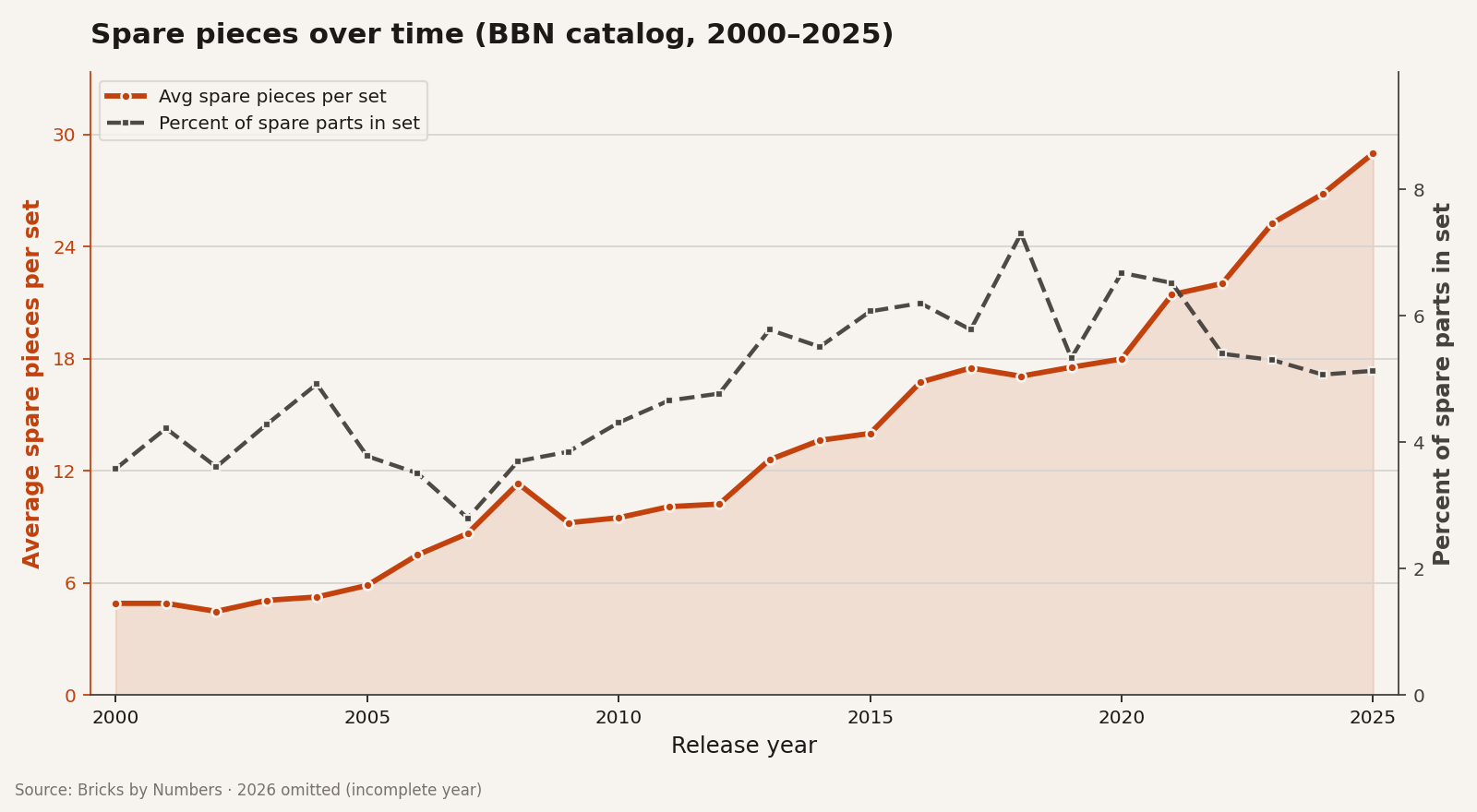
Average spare pieces per set and percentage of spare parts per set, 2000–2025

What the numbers show

In the early 2000s, a typical set in our catalog shipped with about five spare pieces. By 2010 that average sat near ten. Mid-decade it climbed into the mid-teens. In 2025, the average is about 29 spare pieces per set — roughly five times the early-2000s level.

hat rise is steady enough to see by eye on the chart above (solid line). It is not a one-year blip.

Year Avg spare pieces Avg spare share of set
2000 4.9 3.6%
2010 9.5 4.3%
2015 14.0 6.1%
2020 18.0 6.7%
2025 29.0 5.1%

Bigger bags, bigger sets

Absolute spares are only half the story. Average total parts in those same sets grew from roughly 260 pieces around 2000 to roughly 740 in 2025. When the whole box gets larger, a larger spare pile is partly expected.

So we also tracked spare share: spare quantity as a percentage of the set’s total parts (dashed line on the chart). That share floated around 3–5% in the 2000s, rose toward 6–7% in the mid-to-late 2010s (with a spike near 7.3% in 2018), and has settled closer to about 5% in recent years — even while absolute spare counts kept climbing.

In other words: LEGO is putting more spare pieces in the box, but those extras are not claiming a larger slice of the parts list than they did a decade ago. Much of the “fatter bag” feeling is the set growing underneath it.

How to read the chart

A few caveats keep the story honest.

Outliers exist. Mosaic-style products and other special cases can pack hundreds of “spare” tiles in many colors. Those inflate a year’s maximum far more than its average, but they remind us that not every spare row is a lonely cheese slope for emergency repairs.

2026 is unfinished. We left the current year off the chart. Early averages can swing as more sets land in the catalog.

Why this matters on Bricks by Numbers

We include spare pieces in our part counts and value math. They ship with the set, so we treat them as part of what you paid for — imperfect, but better than pretending the yellow bag does not exist. When average spares drift from five pieces to nearly thirty, that choice affects totals more than it used to, even if the spare rate is still a small single-digit percentage of the set.

Verdict

Has LEGO gotten more generous with spares? In raw pieces, yes. A modern set in our catalog typically leaves you with a noticeably larger leftover pile than a set from 2000 or even 2010.

As a share of the set, the picture is flatter. Spare percentage peaked in the late 2010s and has not marched upward with absolute counts. The spare bag got thicker; the set got thicker faster.

So when you sweep those extra 1×1 round plates into a cup after a 2025 build, you are not imagining it — there really are more of them than there used to be. Just remember that the cup sits next to a much bigger box than it did twenty-five years ago.

Read more →

344 Sets - First Half of 2026 Report

Our 2026 year-to-date analysis examined 344 qualifying sets with complete retail pricing and part availability data. Together, these sets represent 257,970 individual pieces, 758 minifigures, 57 themes, and 5,214 spare parts—about 2% of the total piece count.

Buying the Set Still Wins—By a Wide Margin

Across the entire 2026 catalog, the average BVI is 161.07, with a median of 157.23. In practical terms, that means sourcing every part individually costs about 61% more than simply purchasing the sealed set at retail. The close relationship between the average and median also suggests the distribution is relatively balanced, with only a handful of extreme outliers pulling the numbers upward.

The catalog-wide totals reinforce this trend. Purchasing every qualifying 2026 set (to date) at retail would cost $25,756. Attempting to recreate those same sets using Pick-a-Brick and alternate part sources would total approximately $39,492—an increase of more than $13,700, or roughly 53% more than buying the official sets.

The Biggest Outliers

At the top of this year's rankings sits McLaren W1 (77257-1) with a remarkable 320.26 BVI. Although the set retails for just $27.99 and contains 294 pieces, buying every part individually would cost more than three times the retail price. It's a perfect example of how smaller sets can deliver tremendous value despite modest piece counts.

On the opposite end is Cobb Vanth's Speeder (75437-1), posting a 79.91 BVI. Retailing for $34.99 with 207 pieces, it's one of only 11 sets in the entire 2026 lineup to date where sourcing the parts individually is actually less expensive than buying the sealed box.

Large Doesn't Mean Poor Value

Many builders assume larger premium sets offer worse value because of their higher price tags, but the data tells a different story.

Minas Tirith (11377-1) contains an impressive 8,278 pieces and retailing for $649.99. Despite its premium price, it posts a respectable 176.63 BVI, meaning it actually offers a better parts-value ratio than many considerably smaller sets.

This highlights one of the key lessons of BVI: retail price alone rarely tells the full story.

Theme Trends

Some themes consistently deliver stronger value than others.

Among themes with at least three qualifying sets, City > Traffic leads the pack with an average 216.35% BVI across eight sets. Friends follows closely at 211.38 BVI across twenty-nine sets, while the BrickLink Designer Program averages 203.85 BVI across ten releases.

Perhaps the biggest note is Star Wars. Despite its popularity and collectible appeal, the theme averages just 107.99 BVI across twenty-five qualifying sets, making it the lowest average BVI among larger themes in this year's analysis so far.

Price Per Piece Still Matters—But It Isn't Everything

Price per piece remains one of LEGO's most recognizable metrics, but BVI demonstrates why it should never be viewed in isolation.

The standout value belongs to W.A.L.T. (910063-1), which delivers an exceptional 766 pieces for $39.99, or just 5.2 cents per piece, while still posting an outstanding 271.94 BVI. It's an uncommon combination of low cost per brick and excellent overall value.

For contrast, Frozen Creative Box (10462-1) sits at the opposite end of the spectrum with only 37 pieces for approximately 54 cents per piece, illustrating how dramatically price-per-piece can vary across the catalog.

The Bottom Line

With 59 sets—roughly 17% of 2026—posting BVI scores above 200, there are more examples than ever where rebuilding from individual parts would cost more than double the retail price.

Whether you're deciding what to buy next, planning a custom build, or simply curious about the economics behind your favorite hobby, the Bricks by Numbers Value Index provides a different way to evaluate LEGO sets—one built on data rather than assumptions. As the 2026 lineup continues to grow, it'll be fascinating to see whether these trends hold or if new releases reshape the value landscape once again.

Read more →